



Overview
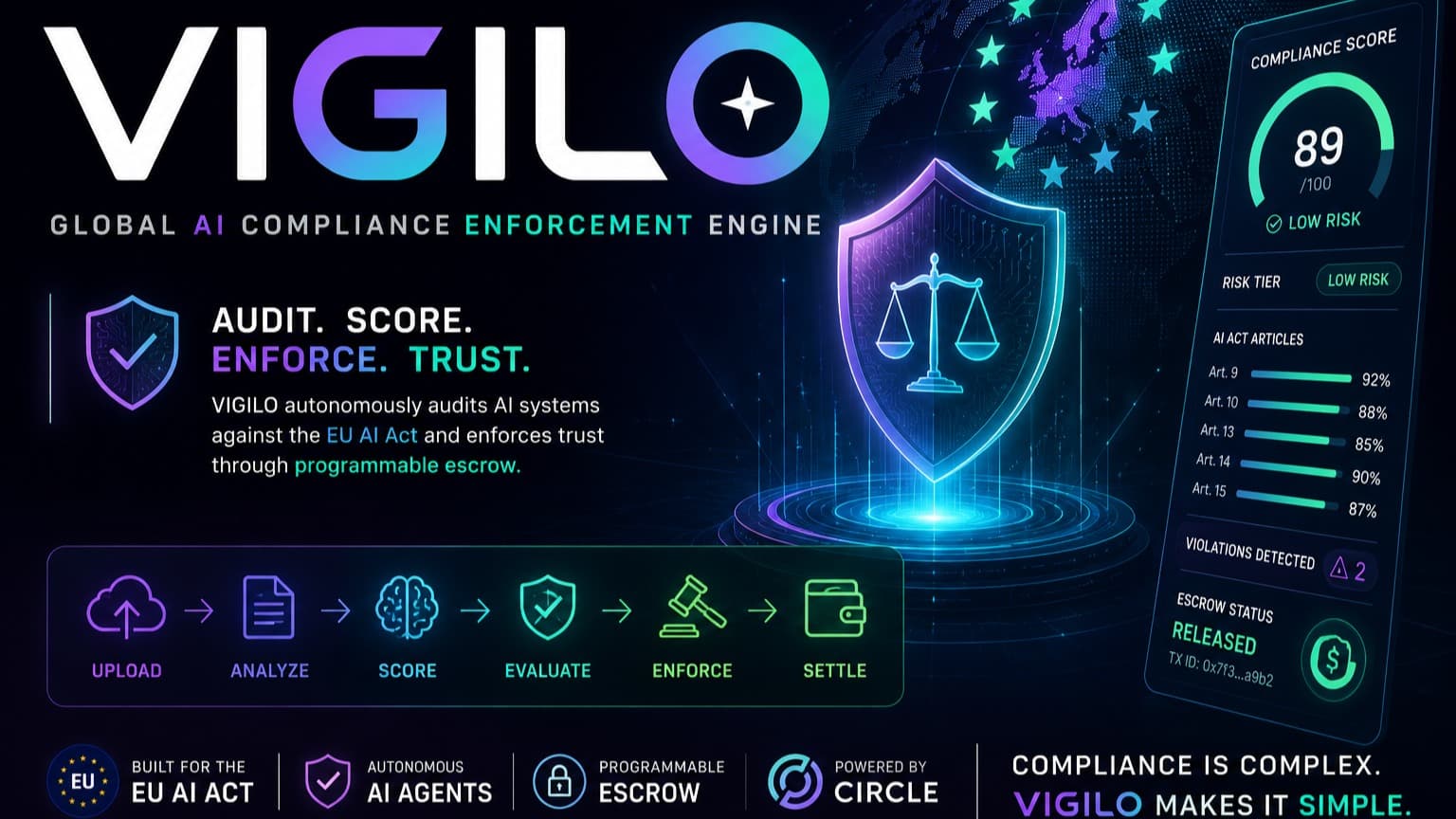
VIGILO is a full-stack autonomous AI compliance enforcement engine built for the EU AI Act. Unlike chatbots that wait for user instructions, VIGILO operates as a true agent: upload one document or code file describing your AI system, and VIGILO takes over completely.
Its multi-agent pipeline — powered by Google Gemini 2.0 Flash for analysis, Featherless Llama 3.1 70B for obligation scoring, and Speechmatics for voice input — autonomously reads the submission, classifies the EU AI Act risk tier (Unacceptable/High/Limited/Minimal), maps it to applicable Annex III categories, scores compliance across Articles 9-15, and generates a detailed remediation report. Every step streams live to the UI via WebSockets.
VIGILO covers both document compliance (policy docs, system descriptions) and technical compliance (code scanning for prohibited patterns, missing human oversight, lack of audit trails). Deployed on Vultr, orchestrated visually via n8n, and open-source under MIT.
Target users: legal teams, CTOs, and AI product managers at companies deploying AI systems in the EU who face real compliance obligations coming into force in 2025-2026.
Note: the demo URL is substituted with the GitHub repository link.
Tech stack
No comments yet
Be the first to comment on this project.
sentinel
Full-Stack Self-Healing DevOps & Security Copilot The Concept: An AI operations engineer that doesn't just suggest code fixes—it monitors cloud infra, detects uptime/security drops, automatically provisions fixes, and generates audit reports for enterprise compliance.
Agency Compiler
Agentic creative project compiler. Most creatives, agencies and designers dont know how to use ai, none the less agents. We created a platform that allows a creative agency or studio owner to instantly spin up agents based on the project ask, resources and scale.
ProofRun
ProofRun helps developers answer a critical question before shipping: will this update break behavior users rely on? An AI agent inspects two Git revisions, designs targeted experiments, and proposes repairs. An independent Docker-based verifier runs those experiments against both versions, preserves the original tests, and checks whether the repair actually works. Developers receive an update, skip, or postpone recommendation with recorded evidence and a reviewable patch. In a live synthetic…