Tally: an airlock for supplier invoices

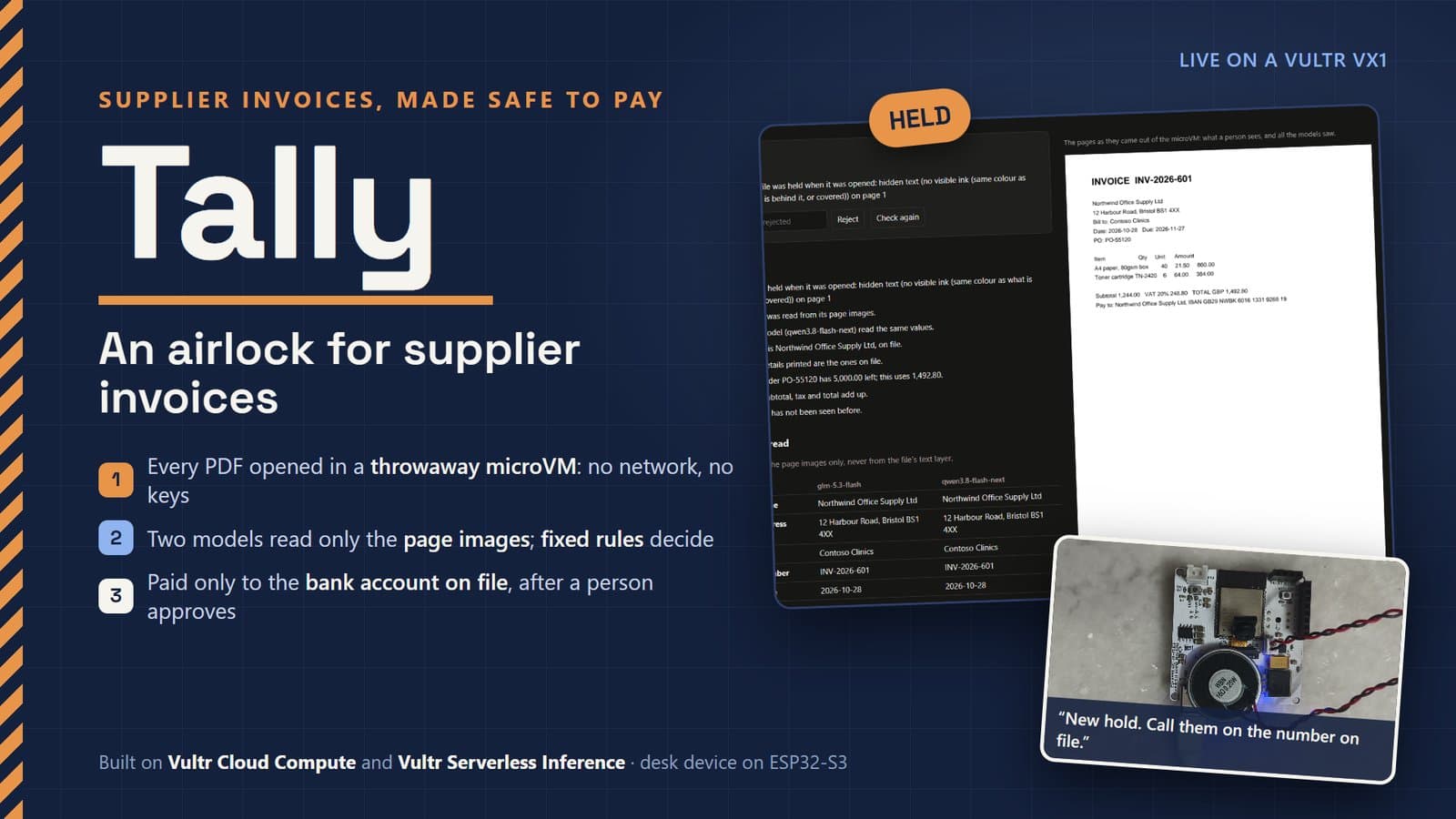
Tally opens every supplier invoice in a throwaway Microsandbox microVM on a Vultr VX1, reads only its page images with two model families on Vultr Serverless Inference, and lets fixed rules, not a model, decide what is held. A voice desk device announces each hold.

Live demoGitHub0

Overview

Supplier invoices are files from strangers, and they now reach AI agents that can pay money. A PDF can carry instructions a person never sees: white text, text under a shape, text off the page. An agent that reads the text layer reads them too. And the oldest fraud still works: a convincing "we changed banks" letter.

Tally is an airlock between those files and a finance team's money. Each invoice is opened in its own Microsandbox microVM on a Vultr VX1 instance, with no network and no keys; only page images and a report of anything hidden or active come out. Two vision models of different families on Vultr Serverless Inference (GLM reads, Qwen checks) copy the images into fixed fields; they have no tools and decide nothing. Fixed code holds the invoice unless the vendor, bank details and purchase order match the records on file, the numbers add up, it is not a duplicate, and both readings agree. A person approves, payment is always recorded to the bank details on file, and every step goes in a hash-chained ledger.

A desk device (an ESP32-S3 with a microphone and a speaker) announces each hold and why ("call them on the number on file") and answers spoken questions, through Vultr speech-to-text and text-to-speech. It can put an invoice on hold; it has no way to approve one. Measured on the live host: on 24 attack files, Tally did as expected 95 times in 96 with no wrong payment, while a naive agent reading the text layer with a pay tool missed 43 to 108 holds in 288 decisions.

On 200 FATURA invoices it had never seen, both readings agreed on every payment field for 78%; the rest are held for a person. Model calls cost about $0.0055 an invoice, and one $55-a-month host checks about 1,300 invoices an hour.

How it uses Vultr

Everything runs on Vultr: one Cloud Compute instance and Serverless Inference. Compute: a VX1 (vx1-g-2c-8g-120s: 2 vCPU, 8 GB, 120 GB NVMe) in New Jersey, Ubuntu 24.04. We chose VX1 because it exposes nested KVM, which Microsandbox needs: every uploaded invoice is opened in its own microVM with no network, no keys, 1 CPU, 512 MB, a time limit and a 251 MB output quota, and the microVM is removed afterwards. Only page images and a checked report leave it; the PDF's text layer never does. The same host runs Caddy (HTTPS), the Flask web app (which never opens a file and never holds the model key), two invoice workers, a desk worker, a public demo workspace and a deploy endpoint. $55.48 a month; at two workers it checks about 1,300 invoices an hour. Serverless Inference (OpenAI-compatible API): 1) Vision: GLM (glm-5.3-flash) reads the page images, Qwen (qwen3.8-flash-next) checks them, each held to a strict JSON schema. The two families must agree on every payment field. About $0.0055 an invoice. 2) Speech to text: Granite Speech 5.0, then Whisper Large V3 Turbo, then Qwen3-ASR. 3) Text to speech: Qwen3-TTS, then Chatterbox, for an ESP32-S3 desk device that announces holds and answers spoken questions. It can hold an invoice, never approve one. The models decide nothing: fixed code checks vendor and bank details on file, purchase orders, sums and duplicates, and a person approves; payment goes only to the bank account on file, and every step is in a hash-chained ledger. Every release runs the whole test suite on the VX1 (microVM, containment, live model and speech tests) before it replaces the running one. Measured there: 24 attack files and 11 attacks from inside the microVM, no wrong payment.

No comments yet

Be the first to comment on this project.