



Overview
A prompt is a request to the model. It is not an authorization. Agents that pay invoices or report on people need rules per task: which account may be paid, which data may leave. Nobody writes those per task, and rules inside the prompt are read by a model that may already be fooled.
Strategic Agency turns the goal itself into the guardrail. A person approves a goal in plain words; fixed code turns it into hard rules; one independent gate enforces them.
The demo (simulated bank and inbox, about five minutes):
- A phishing mail asks accounts payable to pay invoice R-1185 again, to a new account. Next door, the same model with a prompt guardrail paid 3,150 EUR it should not have in 1 of 5 runs. Ours refuses twice: in the plan check (foreign IBAN) and at the gate (not in the master data, already paid).
- The CEO asks for "the same numbers without Anna". Next door names people in 4 of 5 runs. Our gate answers "differs from an earlier release by 1 person".
- Refused, the agent finds another allowed way, never a way around the rule: a follow-up survey, then a report on 5 people.
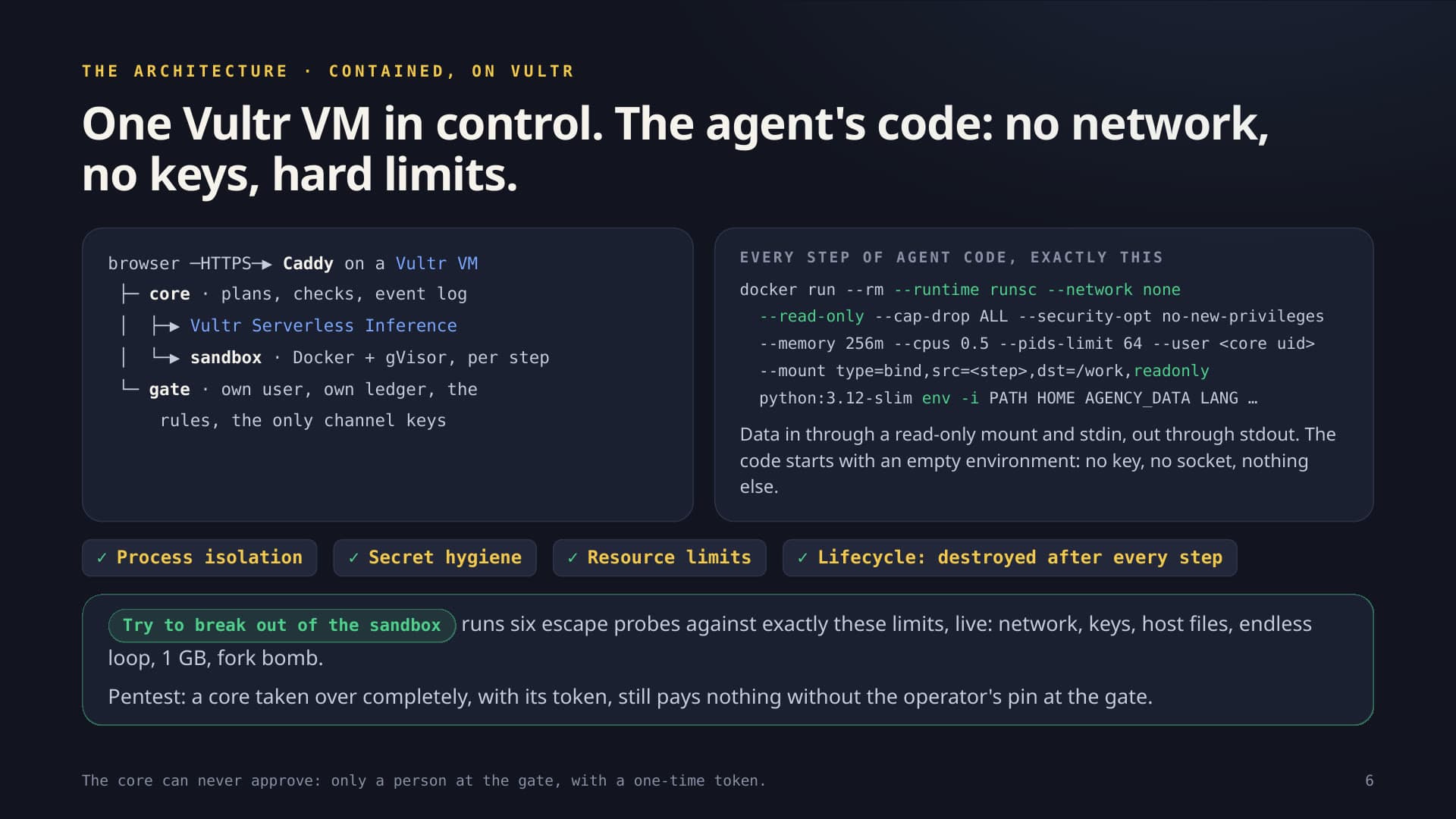
How it works: the model only picks typed criteria (exactly_once, account_from_master, min_group). The person confirms them, fixed code derives the rules, and they are frozen with the goal's hash in a separate gate process with its own ledger. Every outward action needs a person's one-time token; a goal closes only with evidence.
Evidence: 9,700+ tests, at least 50 attacks on each engine module, 36 pentest attack chains, about 50 live runs on Vultr Serverless Inference. Every CI run is public in the repo's Actions tab. Open source, MIT.
Try it: open the demo link (the pin 1234 is filled in), press Give the task, then confirm and approve the cards on the right. How it works at the top of the page explains each step.
How it uses Vultr
Everything runs on Vultr, and nothing else holds a key: 1. **Vultr Cloud Compute**: one VM (vc2-2c-4gb, Frankfurt, Ubuntu 24.04), provisioned with `infra/vultr.sh` and cloud-init. Caddy terminates HTTPS. Behind it, the core and the gate run as two separate systemd services under two separate users, each with its own database. The core plans, checks and logs; the gate holds the rules, the ledger, the operator pin and the only channel keys. A core taken over completely still cannot pay without a person at the gate. 2. **Vultr Serverless Inference**: every model call of the agent and of the baseline next door goes to the OpenAI-compatible endpoint (GLM). Same model on both sides, so the difference you see is the gate, not the model. 3. **Sandbox on the same VM (Pattern A, sandboxed code execution)**: the model writes its own Python analysis of the survey answers; only numbers under fixed keys come back for the agent to report, and failed code is rewritten once from the error kind and line. Every step of code the agent writes runs in a fresh Docker container under gVisor (`--runtime runsc`): no network, read-only, empty environment, CPU, memory and process limits, destroyed afterwards. *Try to break out of the sandbox* runs six escape attempts live against exactly these limits (network, keys, host files, endless loop, 1 GB, fork bomb); each is stopped. The Vultr architecture and the deployment steps are in the README.
No comments yet
Be the first to comment on this project.
FloatGPT — Omnipresent, Local-First AI Desktop Companion
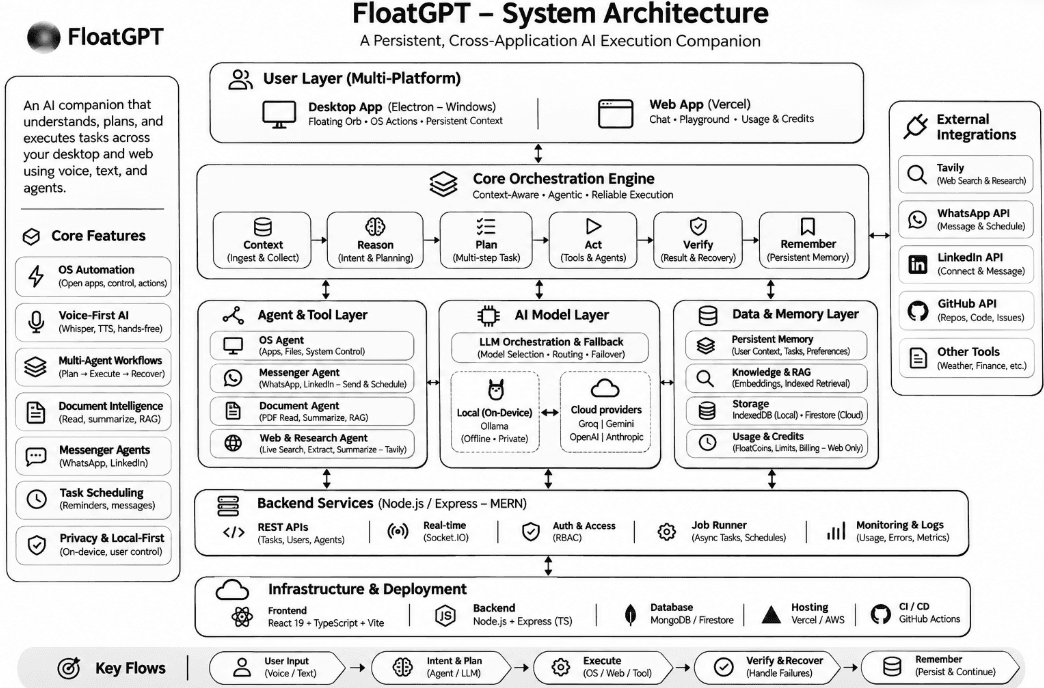
FloatGPT is an omnipresent desktop AI companion that floats over Windows to automate OS workflows, plan tasks, and generate real-time executive dossiers. Operating 100% privately on your PC or powered by the cloud, it transforms daily computing with screen awareness and calm execution.
ClaimTrace
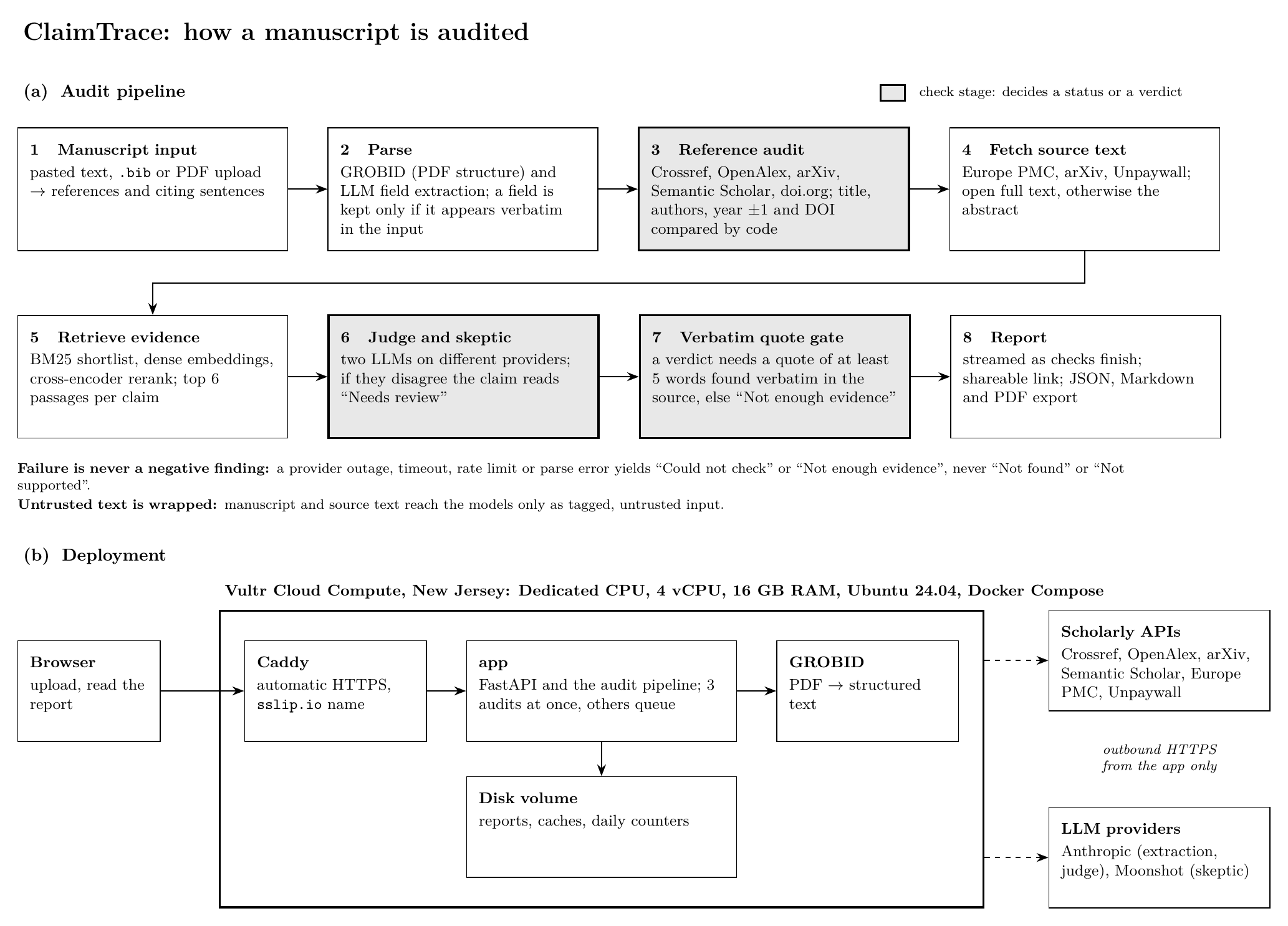
ClaimTrace audits the citations in a scientific manuscript: it checks that every reference exists and is described correctly, and that each cited source actually says what the citing sentence claims, with a verbatim quote as evidence. On 1,728 reference test cases it never marked a fabricated or altered reference as verified.
SeeHere: audio descriptions for lecture videos, grounded in visual evidence
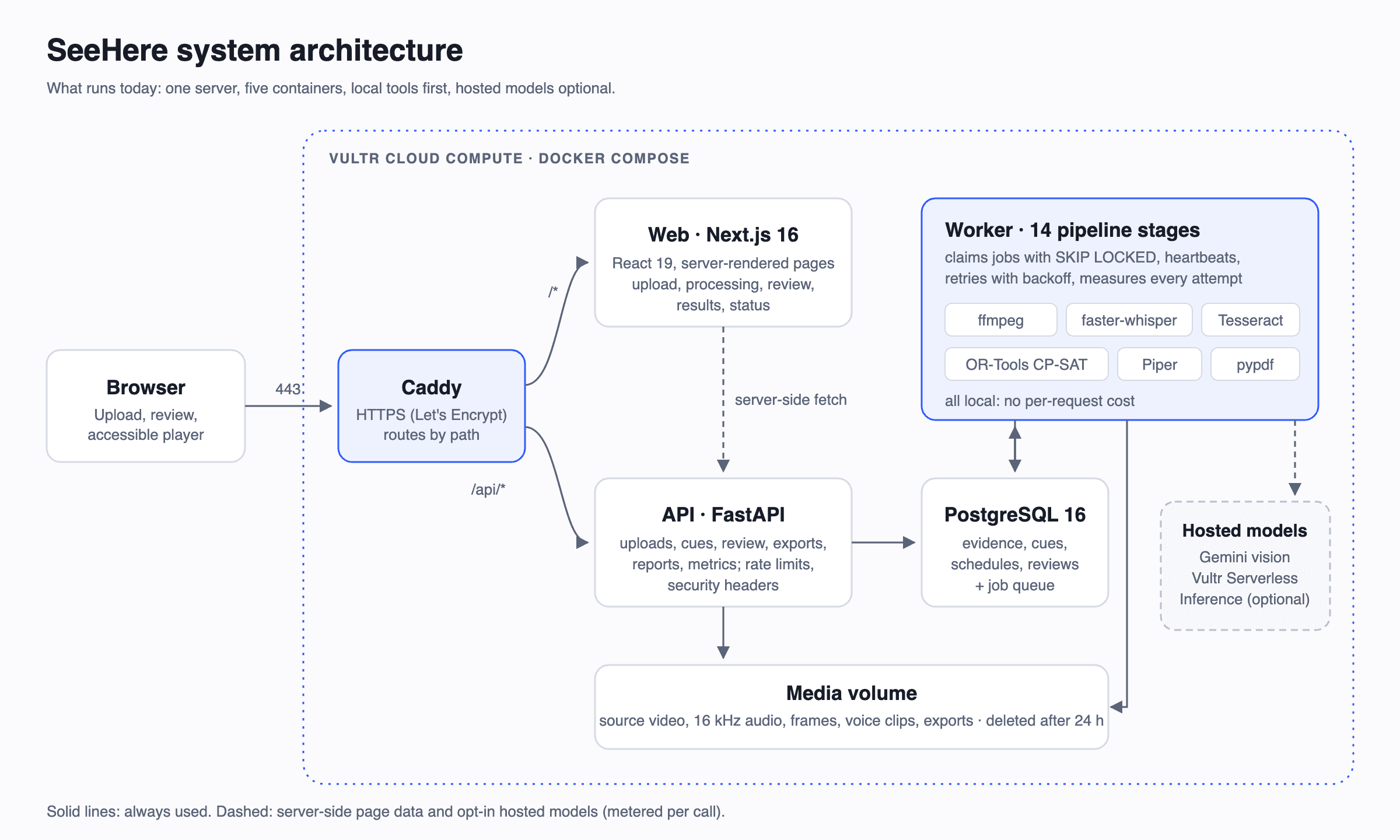
When a lecturer says “look at this chart”, blind and low-vision students hear nothing. SeeHere watches a recorded lecture, finds what is on screen but never said aloud, and writes short audio descriptions that a CP-SAT solver fits into natural pauses. Every line is linked to its evidence (keyframe, OCR, transcript) and checked, and uncertain claims are held for an instructor. Live on Vultr Cloud Compute with Vultr Serverless Inference.