Overview
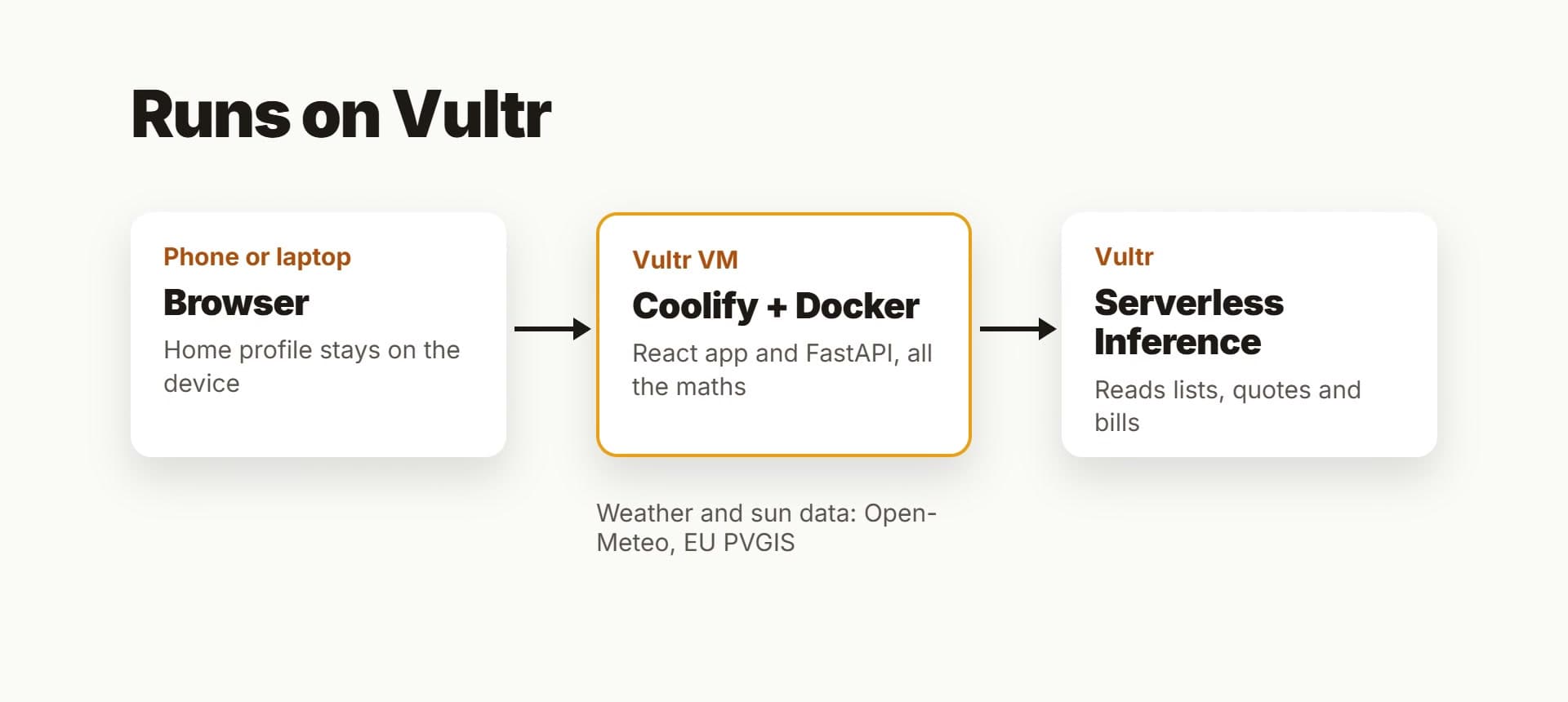
Rooftop solar is booming in Pakistan, but households decide blind: which panels, how to place them, when to run appliances during load-shedding, and whether a quote or a bill is fair. Solar Copilot answers all of that from one home profile, kept only in the browser (no account, no database).
Six tools: (1) Plan my system: tilt and direction from EU PVGIS, how many panels fit the roof, row spacing so rows never shade each other in winter, mounting height, size for your bill, and panel technology for your heat and dust. (2) Tomorrow's plan: an hour-by-hour appliance plan from the Open-Meteo solar forecast, battery and outage schedule. (3) Cleaning alert: dust loss vs wash cost, and whether coming rain will clean the panels. (4) Quote checker: flags undersized or mismatched parts, missing protection and prices outside normal ranges, with the rule behind each warning. (5) Bill slab coach: explains your tariff slab and how many units to save to drop one. (6) Backup compare: generator vs UPS vs solar + battery, cost per outage hour and payback.
Why you can trust the numbers: the AI only reads text and explains; every number comes from tested Python (233 tests). Each result shows its inputs, assumptions and sources; tariffs, prices and rules live in versioned files and are editable in the app. Quotes and bills are treated as untrusted input.
Data: PVGIS (EU JRC), Open-Meteo forecast / air quality / archive, Ember grid CO2 via Our World in Data, NEPRA tariff S.R.O. 279(I)/2026.
Demo video: https://youtu.be/E7hz4AyvZcY



Wow Amazing guys