


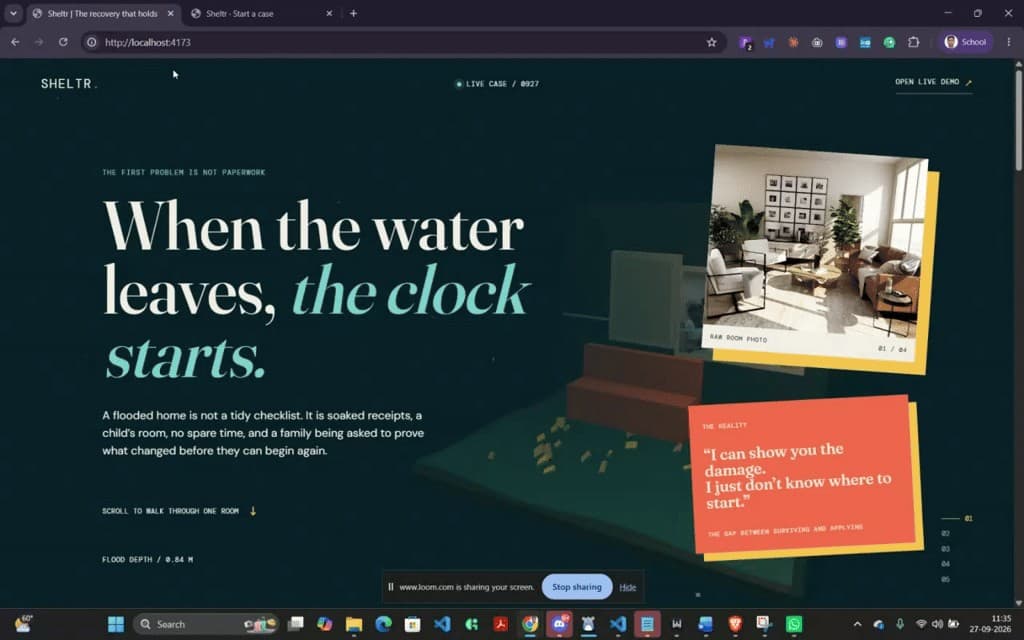

Overview
After a flood, families have to prove every loss to get aid, and in the same week scammers target them with fake relief websites. Professionals document damage with 3D digital twins (Matterport reports claim estimates 400% faster)
Sheltr gives the survivor that evidence from one phone photo or video. An agent on Vultr (glm-5.3 on Serverless Inference) plans the case and dispatches every risky step to its own Microsandbox microVM on a Vultr VX1:
it rebuilds the room in 3D (Depth Anything V2, no network), finds and prices the damage, writes Python to measure it (shown live with its retry loop), builds a 4-page PDF with SHA-256 fingerprints, opens a suspicious "aid" link in a sealed browser, where the forced malware download is captured and the data theft is blocked, fills the aid application live on screen.
The survivor can edit every field the agent typed. Nothing is submitted until they approve, and the submit runs in a fresh microVM. Keys never enter a sandbox, the sandbox host has no public ports, and every microVM is destroyed after its job. The aid portal and scam site are our own mocks; the agent never touches a real government site.
Note: the demo URL is substituted with the GitHub repository link.
Tech stack
No comments yet
Be the first to comment on this project.
sentinel
Full-Stack Self-Healing DevOps & Security Copilot The Concept: An AI operations engineer that doesn't just suggest code fixes—it monitors cloud infra, detects uptime/security drops, automatically provisions fixes, and generates audit reports for enterprise compliance.
Agency Compiler
Agentic creative project compiler. Most creatives, agencies and designers dont know how to use ai, none the less agents. We created a platform that allows a creative agency or studio owner to instantly spin up agents based on the project ask, resources and scale.
ProofRun
ProofRun helps developers answer a critical question before shipping: will this update break behavior users rely on? An AI agent inspects two Git revisions, designs targeted experiments, and proposes repairs. An independent Docker-based verifier runs those experiments against both versions, preserves the original tests, and checks whether the repair actually works. Developers receive an update, skip, or postpone recommendation with recorded evidence and a reviewable patch. In a live synthetic…