SeaShield AI
A Trust Engine for Ocean-Sensor Data
1. The Problem
Coastal disaster-warning centres rely on ocean buoys and sensors to detect dangerous waves and storms. However, they often trust incoming sensor data without being able to determine whether it has been manipulated.
An attacker could:
- Inject fake waves: Make normal sea conditions appear dangerous, triggering unnecessary evacuations.
- Hide a real storm: Manipulate readings to prevent a genuine disaster warning from being issued.
- Replay old messages: Resend previously valid readings to mislead the warning centre.
- Tamper with sensor data: Modify readings while making them appear legitimate.
These attacks can have serious consequences: false alarms, delayed responses, financial losses, and potentially human casualties.
2. Our Solution
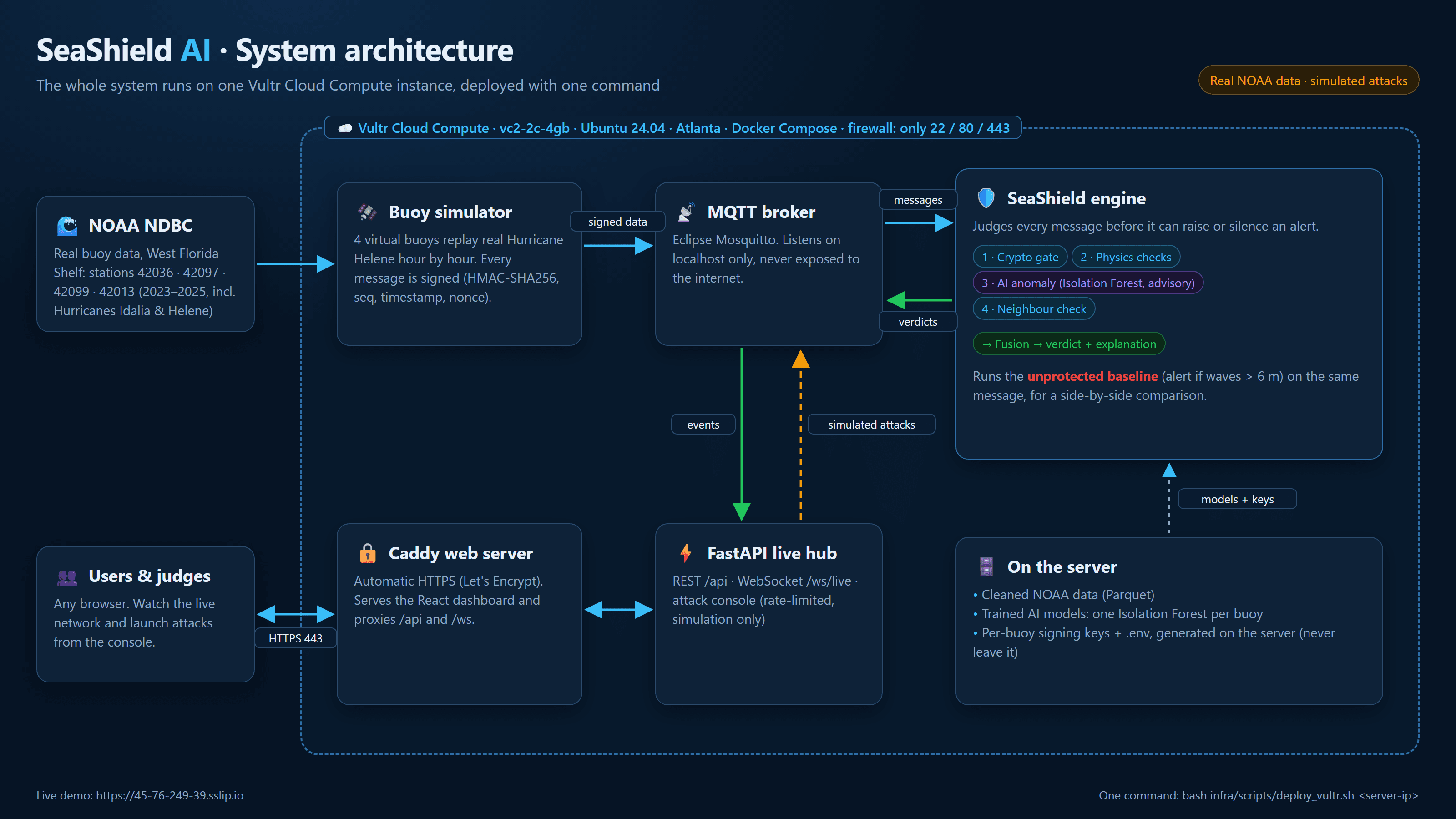
SeaShield AI is an intelligent security layer positioned between ocean buoys and coastal disaster-warning centres.
It evaluates every incoming reading through four complementary layers of protection:
1. Cryptographic Security Gate
Each buoy uses cryptographic authentication, sequence numbers, timestamps, and nonces to verify message integrity and authenticity. This prevents unauthorized modifications and replay attacks.
2. Physics-Based Validation
Using three years of historical buoy data, SeaShield establishes physically realistic limits for ocean measurements. It identifies impossible values, abnormal wave heights, and physically implausible changes between consecutive readings.
3. AI-Powered Anomaly Detection
An Isolation Forest model is trained on real 2023 buoy data, including observations from Hurricane Idalia. It identifies unusual patterns in sensor readings and provides an additional layer of anomaly detection.
4. Neighbouring Buoy Verification
SeaShield compares readings from geographically nearby buoys. When several independent sensors report consistent conditions, the system gains confidence that an event is genuine. Disagreements can reveal compromised or malfunctioning sensors.
Final Verdict
Every reading receives a security assessment:
- Attack: Evidence of tampering, replay, or malicious manipulation.
- Confirmed Real Event: Multiple independent sources support the reported ocean conditions.
- Potential Hidden Storm: Evidence suggests that a real dangerous event may be concealed or suppressed.
No suspicious data is silently deleted. Flagged readings are preserved, and human operators review critical decisions.
3. Results and Validation
SeaShield AI was evaluated using real NOAA ocean-buoy data from 2024–2025.
Key results include:
- Zero false alarms from physics-based validation in the evaluated dataset.
- 100% detection of extreme wave-height anomalies in the tested wave-buoy scenarios, including readings exceeding +7.5 metres.
- Successful confirmation of Hurricane Helene: Real storm warnings were supported by neighbouring buoy observations and allowed to pass through the system.
- AI remains advisory: The Isolation Forest does not independently block warnings, because genuine hurricanes can naturally produce unusual sensor readings.
The system is designed to distinguish suspicious data from genuine extreme weather without confusing the two.
4. Live Demonstration
SeaShield AI runs on a Vultr Cloud Compute instance.
The live demonstration replays real historical Hurricane Helene data and compares two environments:
- Unprotected warning centre: Receives sensor readings without the SeaShield security layer.
- Protected warning centre: Uses SeaShield AI to authenticate, validate, and assess every incoming reading.
Visitors can launch simulated attacks themselves, including:
- Fake wave injection.
- Hidden-storm scenarios.
- Message tampering.
- Replay attacks.
They can then observe how SeaShield responds and compare the results with the unprotected system.
5. Impact
SeaShield AI aims to protect coastal communities and disaster-response infrastructure from manipulated ocean-sensor data.
By combining cryptography, physical ocean modelling, machine learning, and neighbouring-sensor verification, it helps warning centres make more trustworthy decisions.
Its potential impact includes:
- Reducing unnecessary evacuations caused by false alarms.
- Detecting attempts to conceal genuine storms.
- Improving the reliability of coastal early-warning systems.
- Supporting faster and more informed human decision-making.
SeaShield AI is built around one principle: a sensor reading should never be trusted simply because it arrived.
6. Honest Limitations
We recognize the current limitations of our prototype:
- Attack scenarios are simulated using real historical ocean data.
- Small, physically plausible manipulations may evade detection.
- The system has not yet been validated through deployment on live operational buoy networks.
- Neighbouring-buoy verification depends on sensor availability, geographic coverage, and communication reliability.
- AI predictions remain advisory and do not replace human operators or official meteorological warnings.
SeaShield AI is a research prototype demonstrating how multiple security and intelligence layers can improve trust in ocean-sensor networks.