review dojo

Code review is a daily job skill that almost nobody is taught. Review Dojo gives students realistic pull requests with planted bugs, security holes and performance flaws. You comment on lines you distrust, get scored against a hidden answer key, earn XP, unlock harder missions, collect achievements and climb a leaderboard. Optional AI sensei feedback explains what you missed. Built with React, TypeScript, FastAPI and PostgreSQL, and deployed with Docker on a Vultr Compute instance.

Live demoGitHub1

Overview

What is Review Dojo?

A dojo is a training hall. Review Dojo is a training hall for one of the most important and least taught skills in software: code review. You read realistic pull requests with planted flaws (bugs, security holes, slow code, messy design), comment on the lines you distrust, and get scored against an answer key with a clear explanation of every flaw.

The problem

  • Universities teach writing code, not reading it. Juniors are asked to review code from day one.
  • Weak reviews let bugs and vulnerabilities reach production.
  • There is no safe, scored place to practise. Existing AI tools review code for you; they do not train you.

Features

  • 6 realistic pull request exercises: Python, JavaScript, Java, SQL (beginner to advanced)
  • GitHub-style diff viewer with inline comments (hover a line, click +)
  • Scoring engine: severity-weighted, rewards naming the problem, penalises false alarms
  • Belt ranks: White, Green, Brown, Black, Sensei
  • AI sensei feedback (optional, Claude API) plus a built-in mentor that works with no key
  • Accounts (JWT), profile with skill bars per category, global leaderboard
  • Guests can play without signing up; log in to save scores
  • Dockerised, deployable on a Vultr VM in minutes

How it uses Vultr

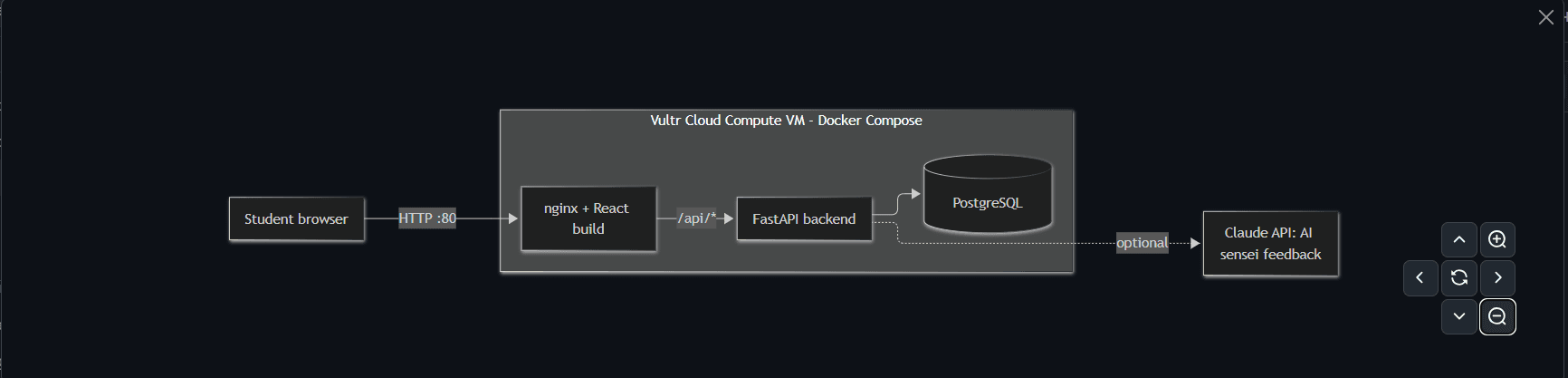
Deployed a Vultr Cloud Compute instance running Ubuntu 24.04 LTS x64 in the Warsaw region (2 vCPUs, 4GB RAM, 100GB NVMe storage) to host the full-stack Review Dojo application via Docker. The setup powers the live backend API (FastAPI, PostgreSQL), the Node.js frontend, and the production container orchestration with automatic backups enabled. Key Details Included: Product: Cloud Compute Region: Warsaw Specs: 2 vCPUs, 4GB RAM, 100GB NVMe OS: Ubuntu 24.04 LTS x64 Use Case: Hosting the containerized Docker environment for both the backend and frontend services.

1 comment

Sorted by votes

Love this concept. Learning to read and audit code is such a massive gap between university projects and real engineering teams.