JaagteRaho: the AI on-call engineer you can afford
Your app breaks at 2 a.m. Small bugs fix themselves. Serious ones ring your phone. No answer in 3 minutes? It heals your app, with one-tap Undo.
Problem
- Live apps, nobody on call. Over 5 million new business applications are filed in the US every year (US Census Bureau, Business Formation Statistics). Freelancers, startups and college tech teams ship live products, and nobody watches them at night.
- Downtime is expensive. 1 in 4 small businesses say one hour of downtime costs them $10,000–$20,000, and 37% have lost customers to it (Infrascale, survey of 500+ SMB executives, 2020).
- Error trackers only collect. They don't decide what is worth waking someone for, find the cause or write the fix.
Solution
JaagteRaho (Hindi for "stay awake") is an AI agent that takes the night shift.
- Small bugs fix themselves: applied when every guard passes, a quiet note afterwards, one-tap Undo.
/heal minor off puts you back in charge. - Serious bugs ring your phone: login, exam or payment failures get a real phone call (Twilio). Press 1 and the cause is waiting on Telegram.
- No answer in 3 minutes: it heals under your rules, watches the errors, and rolls back if they don't drop.
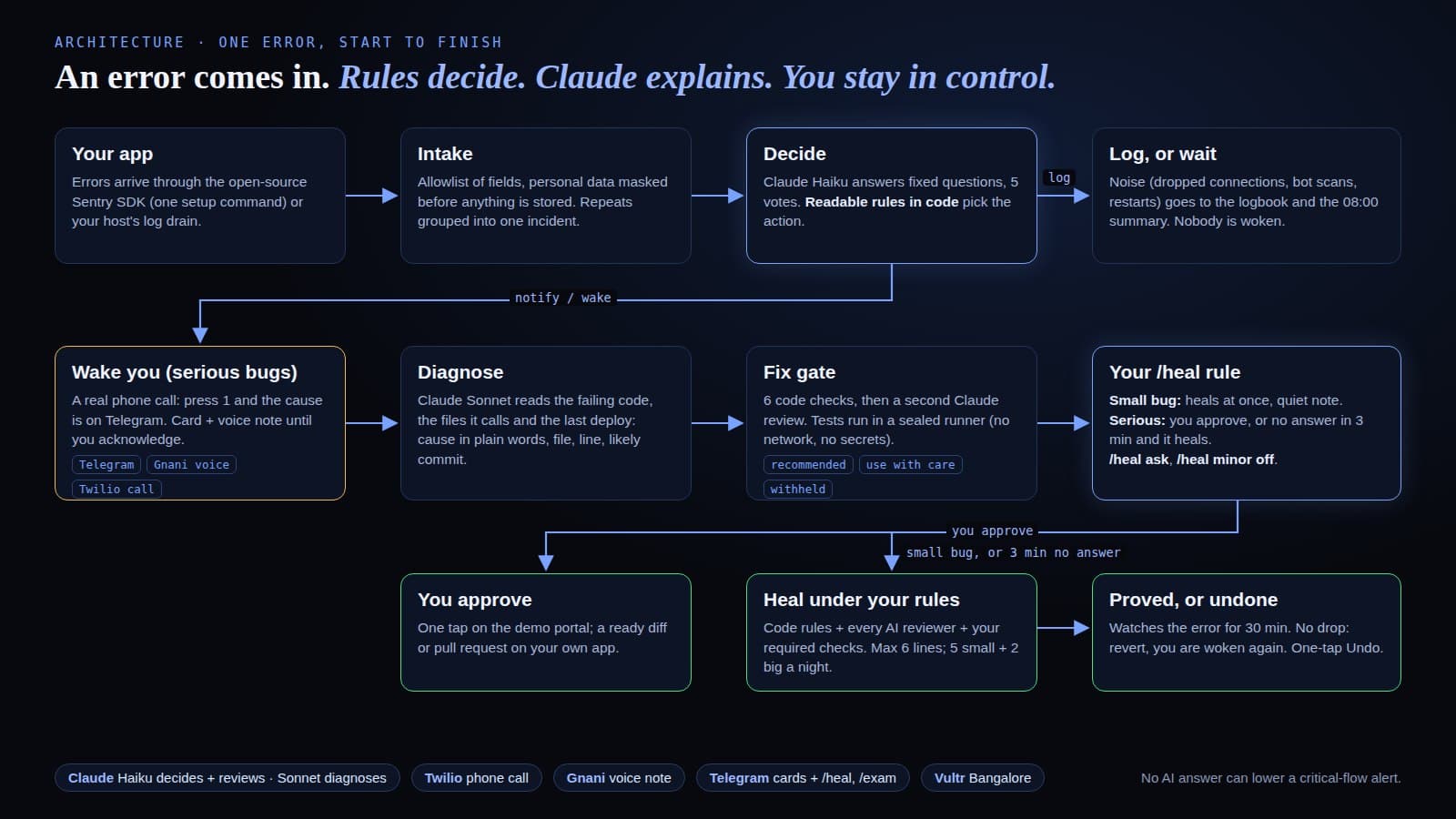
- Rules decide, not the AI: Claude answers fixed questions; readable rules in code choose wake, message or the 08:00 summary. No AI answer can lower a critical alert.
- Strict guards: a fix goes in without you only if the code rules pass, every AI reviewer agrees and your repo's own required checks pass. Never in payments, login, sessions, exams or config; never if it removes a check or changes more than 6 lines; at most 5 small and 2 big heals a night.
How it works
- Connect: apps on Sentry's open-source SDK change one setting; others run
jaagteraho init, which shows every change before writing it. - Intake: personal data masked before storage; repeats grouped into one incident.
- Decide (about 1.7 s): Claude Haiku votes five times on fixed questions; rules pick the action.
- Diagnose: Claude Sonnet reads the failing code, the files it calls and the last deploy: cause, file, line, likely commit.
- Gate (about 11 s to a fix): six code checks plus a second Claude review. All AI-written code runs only in a sealed runner: no network, no secrets, read-only.
- Act: heal, call or wait, by your rules. Every heal is watched, rolled back if errors don't drop, and undoable in one tap.
Try the Playground: 7 live apps, 70 planted bugs. Pick a bug, toggle exam time and the heal rule, press the app's own button (a real 500), approve the fix, press it again (a real answer), then Undo.
Traction
- Live: Vultr Cloud Compute (Bangalore), published on npm
- Real product: Watches Faurus (code.faurus.app, ~11,000 accounts) in suggest-only mode, no changes on its own
- Phone wake-ups: Real Twilio calls tested end to end
- Bugs that reached the owner: 70 of 70
- Fixed and proved by a hidden test the AI never saw: 62 of 70 (89%)
- Wrong fixes shown: 5 of 64: 4 labelled "use with care"; 1 of the 20 that could heal alone (Undo covers it)
- Speed: ~1.7 s to decide, ~11 s to a fix
- AI cost: $1.19 for all 70 bugs (≈ ₹1.4 a bug)
- Real production codebase (Faurus, private copy of 43 files): 294 planted bugs: 182/182 critical submission/exam/contest bugs woke the owner; right file 293/294; 96% of fixes passed a hidden test; ≈ $0.019 a bug
- Live Playground, all 70 bugs run end to end (15 Nov): 64/70 fixes approvable in the visitor's copy; 61 of those passed the hidden test; 0 errors
- Security: Two independent reviews, every finding fixed
Why I built it
I'm the founder of Faurus (code.faurus.app): an all-in-one coding lab for colleges and students, where a student practises everything from HTML and CSS to DevOps, and colleges run exams and contests on it (about 11,000 accounts). When an exam or a contest broke at night, we didn't know until students told us the next morning.
We are not alone. Startup founders don't know when their platform breaks. Freelancers ship products, and their clients never learn why something stopped working, or who should fix it. None of them can afford an on-call engineer. JaagteRaho is that on-call engineer, and Faurus is its first real user: it watches Faurus today in suggest-only mode.
Go-to-market
- Who first: freelancers, startups and college tech teams in India.
- One-setting connect: any app on Sentry's open-source SDK switches by changing its DSN; everyone else runs
npx jaagteraho init (live on npm). - Channels: developer communities and colleges, starting with the colleges on Faurus.
- Free to start: $5 of AI credit per account; deciding and alerting are always free.
Built with
TypeScript + Hono + SQLite (watcher), Next.js (site), Django (demo apps), Claude Haiku and Sonnet (Anthropic API), Twilio (calls), Gnani (Indian-English voice notes), Telegram (cards and commands), Docker Compose on Vultr.
Run it yourself
A ✅ arrives on Telegram; send /heal to see your rule. To run the whole system locally, see "Run it locally" in the README.
Team
Anant Vardhan Pandey: solo founder and builder (founder of Faurus).