Overview
The Problem
Technology moves faster than university course materials can be rewritten. Languages, frameworks, and functions reach end-of-life or get deprecated while still appearing in inherited lecture notes and lab manuals. Instructors teaching multiple classes—and department chairs reviewing dozens of modules for accreditation—rarely have time to manually cross-check every tool and version against official release notes. Meanwhile, generic AI chatbots aren't reliable enough for academic review: they invent dates, give opinions without citations, and rewrite course material without understanding why an instructor included a topic in the first place.
The Use Case
GroundEd is built for university instructors, instructional designers, and curriculum reviewers preparing technology courses for the upcoming term:
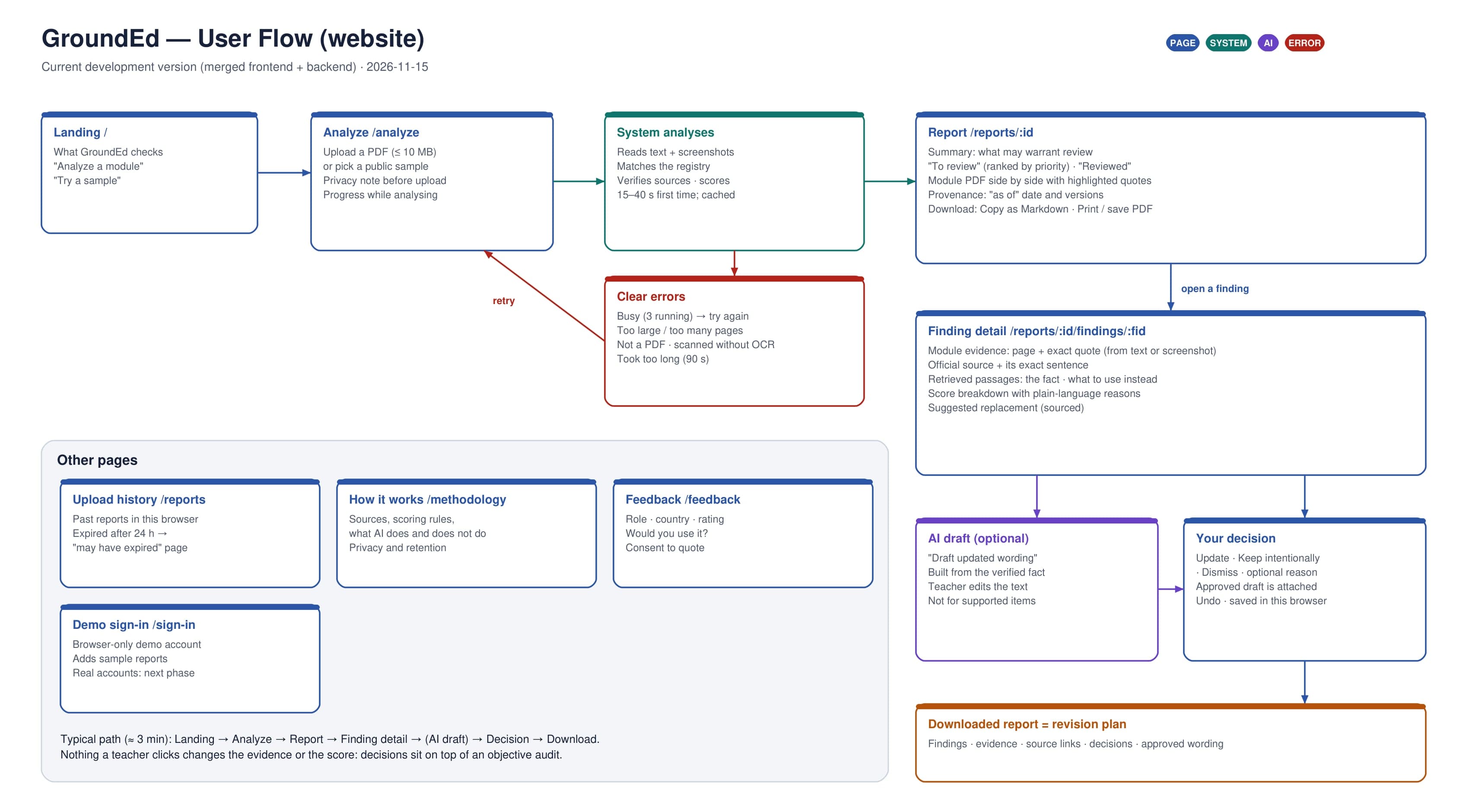
- Side-by-Side Course Review: An instructor uploads a syllabus, lecture handout, or lab manual (PDF) and sees their original document on the left with color-coded highlights beside a ranked list of findings on the right.
- Evidence You Can Defend: Every finding shows two things side by side: the exact quote and page number from the course module, and the official documentation or support-lifecycle record that backs it up.
- Faculty Stay in Control: Sometimes an older tool is mentioned on purpose—for example, for historical context or a migration exercise. GroundEd never changes a course automatically; for each finding, the instructor chooses whether to Update (with a recommended modern replacement or an editable AI-drafted rewrite), Keep intentionally, or Dismiss, then exports a complete, annotated PDF report to share with their department.
How It Works
GroundEd is built around a strict "No Source, No Claim" principle that separates verified facts from AI suggestions:
- Read & Locate: When a PDF is uploaded, GroundEd reads each page and maps the exact position of every technology, version, function, and coding practice mentioned in the material.
- Verify Against Trusted Sources: Each mention is checked against a curated library of official documentation and release-lifecycle records (endoflife.date). If GroundEd cannot back a technology with a trusted source, it marks it as Unverified for a manual check—it never guesses or invents a claim.
- Retrieve Context & Replacements: Using full-text retrieval over official documentation, GroundEd pulls the exact passage explaining why a feature was deprecated or removed, along with official guidance on what to teach instead.
- Score by Curriculum Impact: Rather than letting an AI guess what is important, GroundEd calculates a transparent 100-point priority score based on four clear factors: whether the technology is no longer supported, how deeply the module teaches it (hands-on student code vs. a brief mention), how often it appears across pages, and whether students use it in a lab exercise.
Decide & Export: Instructors can optionally ask Google Gemini to draft updated wording based on the verified source—always clearly labeled as an AI suggestion for the instructor to edit and approve—and export a multi-page, annotated PDF report containing the highlighted module pages, sources, and faculty decisions.