



Overview
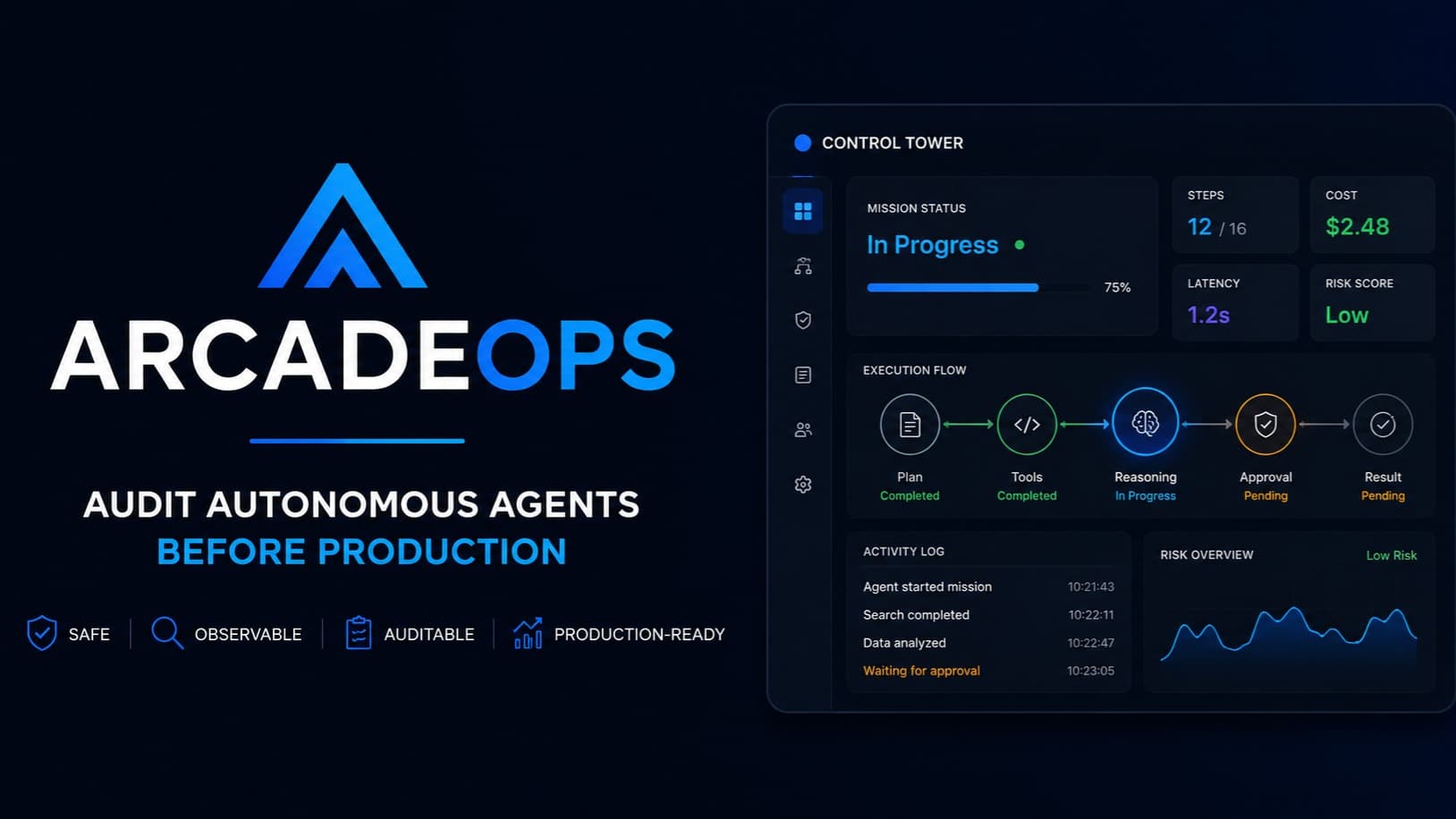
ArcadeOps Control Tower is a production cockpit for autonomous AI agents.
Most AI agent demos stop at the final answer. In real companies, that is not enough. Teams need to understand what the agent planned, which tools it used, what risks appeared, what actions required approval, how much the run cost, and whether the result is safe enough for production.
ArcadeOps turns an autonomous agent run into a clear, auditable mission workflow. The interface shows the mission objective, execution steps, tool calls, approvals, evidence, observability signals, and final result in one control tower view.
The product is designed for enterprise teams that want to use autonomous agents across operations, sales, support, marketing, HR, research, and internal automation without losing control. Instead of treating agents as black boxes, ArcadeOps makes them observable, reviewable, and production-ready.
For the hackathon demo, ArcadeOps shows how a team can launch an agent mission, follow its execution, review the audit trail, and decide whether the output is safe enough to move forward.
Other agents execute tasks. ArcadeOps decides if they are safe enough to touch production.
Note: the demo URL is substituted with the GitHub repository link.
Tech stack
No comments yet
Be the first to comment on this project.
sentinel
Full-Stack Self-Healing DevOps & Security Copilot The Concept: An AI operations engineer that doesn't just suggest code fixes—it monitors cloud infra, detects uptime/security drops, automatically provisions fixes, and generates audit reports for enterprise compliance.
Agency Compiler
Agentic creative project compiler. Most creatives, agencies and designers dont know how to use ai, none the less agents. We created a platform that allows a creative agency or studio owner to instantly spin up agents based on the project ask, resources and scale.
ProofRun
ProofRun helps developers answer a critical question before shipping: will this update break behavior users rely on? An AI agent inspects two Git revisions, designs targeted experiments, and proposes repairs. An independent Docker-based verifier runs those experiments against both versions, preserves the original tests, and checks whether the repair actually works. Developers receive an update, skip, or postpone recommendation with recorded evidence and a reviewable patch. In a live synthetic…