ADRISHTA: Invisible Waves, Intelligent Sensing.

ADRISHTA leverages Wi-Fi signals from low-cost microcontrollers for non-invasive presence sensing, people estimation, and fall detection. This provides an affordable, privacy-friendly alternative to cameras for monitoring residents in old age homes, while also being sensitive enough to track patient breathing patterns for medical diagnostics. Additionally, the system includes a built-in dataset collection feature to help train future AI models for advanced non-optical pose estimation.

Live demoGitHub0

Overview

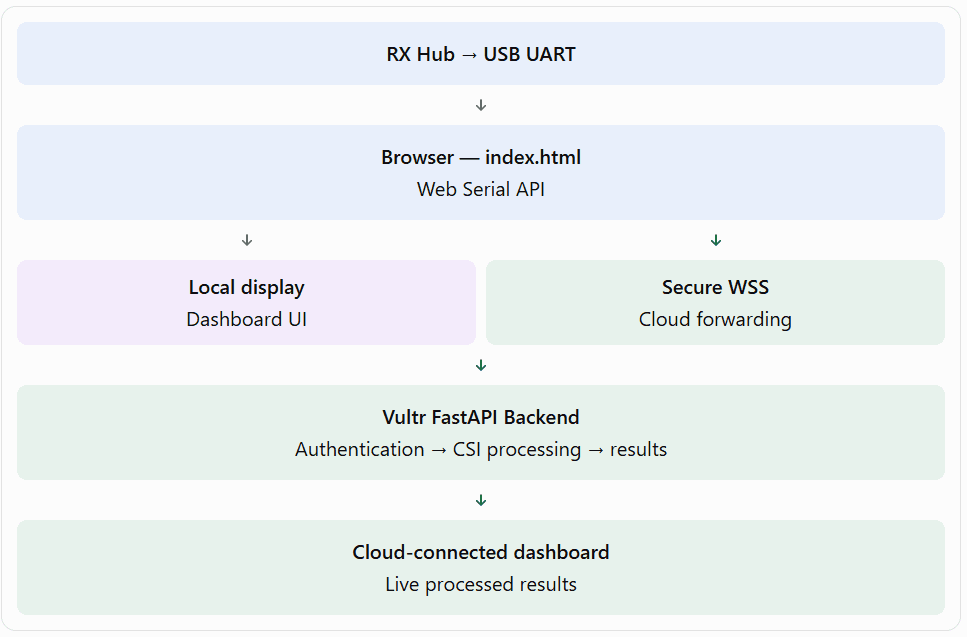
ADRISHTA is a non-invasive human sensing system that extracts WiFi Channel State Information (CSI) to perform real-time presence detection, people estimation, and fall detection. The architecture spans edge hardware, a processing backend, and a web interface:

  • ESP32 Firmware Network: A dedicated TX Node constantly broadcasts 100 Hz WiFi beacons. Distributed Satellite RX Nodes capture the CSI disruptions caused by human movement in the room and forward compact 60-byte frames via ESP-NOW. A central Hub RX Node collects these forwarded packets alongside its own local CSI data, outputting a unified 52-subcarrier amplitude matrix over UART.
  • Backend Processing: A Python gateway reads the UART stream and routes the raw data into specialized modules. These scripts filter environmental noise and execute classification algorithms for distinct events like falls or breathing patterns.
  • Frontend Interface: An HTML dashboard connects to the backend via WebSockets to render live CSI heatmaps and trigger instant visual alerts when a fall or new presence is detected.
  • Cloud Infrastructure: A Vultr cloud server hosts the Python backend and data logging operations, offloading the heavy computational workload from local microcontrollers or laptops to ensure a stable, continuous monitoring pipeline.

How it uses Vultr

The project utilizes a Vultr Virtual Private Server (VPS) hosted in the Mumbai data centre, configured with Ubuntu 24.04 LTS x64, 2 vCPUs, 8 GB RAM, and 50 GB NVMe storage. This infrastructure directly supported the project in three ways: Uninterrupted Signal Processing: Parsing a continuous 100 Hz multi-node CSI stream requires intensive real-time matrix calculations. The 8 GB RAM and 2 vCPUs provided the necessary computational headroom to run the Python classification engine continuously, eliminating the memory constraints and dropped packets that happen when running heavy scripts on standard local machines. Ultra-Low Latency: Deploying the server in Mumbai ensured minimal routing delay to your local hardware. This optimized network path is essential for pushing dense CSI arrays over WebSockets, allowing the frontend dashboard to update and sound fall alerts instantly. High-Speed Data Logging: Building historical datasets for future neural network training requires saving massive amounts of raw data. The 50 GB NVMe drive delivered the fast disk write speeds needed to rapidly log gigabytes of CSV data without blocking or slowing down the live monitoring and classification threads.

No comments yet

Be the first to comment on this project.